Platform Methodology for Accelerating Global Tech Transfer of AAV Production

PROVEN INTELLIGENCE ACCELERATING NEXT-GENERATION THERAPIES

Platform Methodology for Accelerating Global Tech Transfer of AAV Production

Platform Methodology for AAV Production Tech Transfer

CELL & GENE | RNA | BIOLOGICS

Proven Intelligence Accelerating Next-Generation Therapies.

A close-up of a multi-channel pipette dispensing liquid into a microplate in a laboratory setting, with a blue color overlay.

A close-up, detailed shot of a Sartorius Stedim Biotech BIOSTAT STR® single-use bioreactor in a laboratory setting.

Executive Summary

The transfer of an adeno-associated virus (AAV) production process from development labs to a GxP manufacturing environment is a frequent point of failure and delay for therapeutic programs. A platform methodology, built on standardized processes and a deep library of qualified analytical assays, de-risks this transition. This approach provides process knowledge continuity, streamlines documentation for IND or IMPD submissions, and establishes a clear pathway to material readiness, supporting an 18-24 month timeline to get candidates to IND.

Frequently Asked Questions

    What defines a “platform approach” for AAV tech transfer?

    A platform approach utilizes standardized, pre-validated unit operations for both upstream and downstream processes. It is supported by a comprehensive suite of qualified, phase-appropriate analytical assays and templated documentation, which collectively reduce process variability and accelerate transfer into a GxP-compliant environment.

    How does this methodology mitigate risks during transfer to a CDMO?

    Risk is mitigated by ensuring the same scientific team that executes process development and preclinical production also provides direct oversight for the GMP manufacturing run. This continuity eliminates knowledge gaps and ensures consistent execution. Franklin Biolabs employs this model by providing Person-in-Plant (PIP) services at a strategic partner’s CDMO GMP suite.

    What are the primary components of a GMP-ready documentation package?

    A robust package includes detailed batch records, process descriptions, raw material specifications, and comprehensive analytical testing data with assay qualification reports. The documentation is structured to directly support the Chemistry, Manufacturing, and Controls (CMC) section of regulatory filings.

The Challenge of Process Portability in AAV Manufacturing

An AAV production process developed at research scale often lacks the robustness required for successful transfer to a larger, GxP-compliant manufacturing setting. Each vector, whether a common serotype like AAV8 or a novel engineered capsid, possesses unique biophysical properties that influence process performance. Attempting to scale a poorly characterized process introduces significant risk, leading to inconsistent product quality, batch failures, and extended timelines.

Our platform methodology is designed to address these variables directly. By establishing a well-understood operational baseline for both adherent and AAV scalable suspension systems, we can more efficiently optimize for serotype-specific behaviors and purification requirements.

A scientist in a lab coat and gloves looks through a microscope in a laboratory setting, with a blue color overlay.

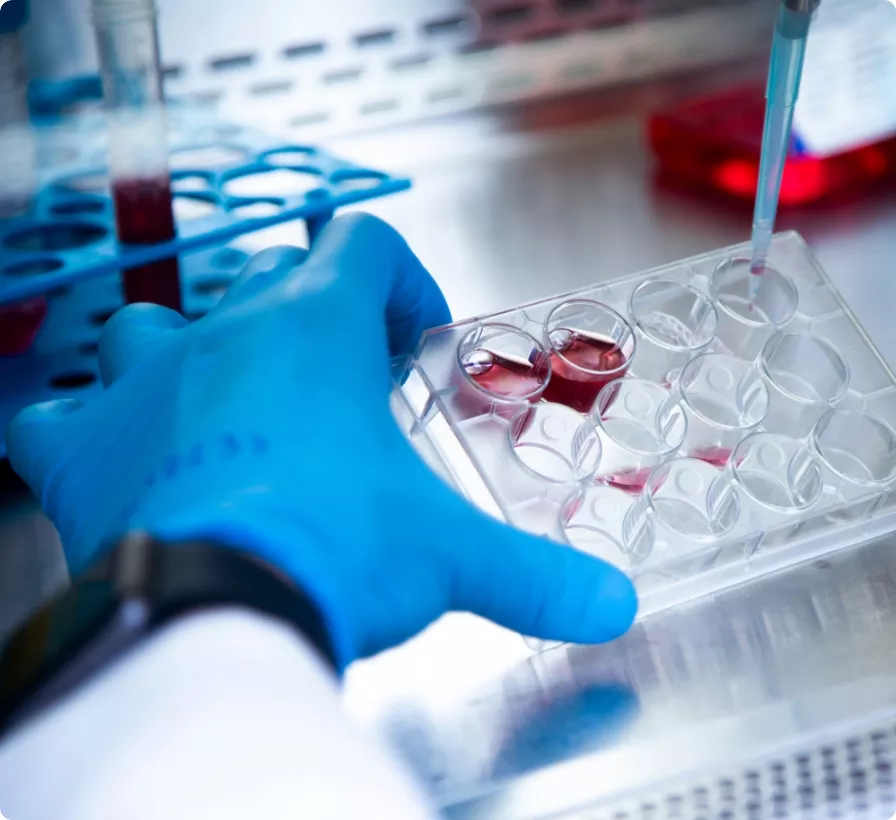
A scientist pipetting a red liquid into a multi-well plate in a laboratory setting.

A Framework for De-Risked Technology Transfer

The foundation of our approach is a set of core, optimized processes that serve as the starting point for every program. This framework, developed within our >100,000 sq ft facility, enables rapid scale-up and predictable performance.

  • Upstream Process: Standardized protocols for transient transfection in single-use bioreactors (2L to 500L+) provide a consistent and scalable starting point.

  • Downstream Process: Platform purification schemes are adapted to meet the specific quality attributes and regulatory requirements of the target therapeutic.

  • QC Analytics: A comprehensive suite of platform assays is available to characterize vector titer, purity, potency, and impurity profiles, supported by development and qualification of gene-of-interest-specific ddPCR assays.

Continuity from Preclinical Supply to GMP Oversight

A significant advantage of this model is the continuity of personnel. The same scientists responsible for early process development and the manufacture of material for IND-enabling toxicology studies are the ones who write the tech transfer documents and oversee the GMP production run. This has been a contributing factor to the 100% successful IND rate since 2019 for programs supported by our teams, even as the Franklin Biolabs brand itself launched in 2024.

“The key people from UPenn Vector Core joined Franklin Biolabs and our partnership transitioned without interruption from UPenn Vecor Core to Franklin Biolabs Research Vector Division. Franklin Biolabs is an integral collaborator in our AAV-vector based gene therapy candidate development, and we hope to continue the partnership for years to come.”
— Biotech Partner

This operational consistency ensures that nuanced process knowledge is not lost during handoffs between organizations. It transforms the tech transfer from a simple document exchange into a managed knowledge transfer, directly supporting program acceleration.

The scientific rationale for this level of process control is clear. The quality of the vector preparation is directly linked to its immunological profile. A consistent process that minimizes impurities is foundational to achieving stable transgene expression and avoiding unwanted host immune responses (PMID: 24126962).
A female scientist in a lab coat analyzes complex biological data, including cellular imagery and DNA models, on a computer screen.

Technical Visualization: AAV Tech Transfer Platform Framework

Scientific Process Diagram

This content is for informational purposes. For guidance specific to your therapeutic program, please contact our team for a consultation.