Biodistribution Studies Capabilities

PROVEN INTELLIGENCE ACCELERATING NEXT-GENERATION THERAPIES.

Biodistribution Studies Capabilities

Proven Biodistribution Frameworks Validating Target Engagement.

CELL & GENE | RNA | BIOLOGICS

A close-up of a scientist in a lab, wearing blue gloves and examining the results of a gel electrophoresis or Western blot.

Biodistribution Studies for Advanced Therapeutics

Quantifying the tissue and fluid distribution of advanced therapeutics and complex biologics is a critical component of any preclinical safety program, supporting both safety and efficacy assessments as well as regulatory approval. Applying proven intelligence in molecular bioanalysis ensures delivery of the precise, reproducible data required to characterize therapeutic kinetics, assess off-target accumulation, and minimize clinical risk ahead of IND submission.

Our bioanalytical platforms are designed to deliver sensitive and specific quantification of therapeutic sequences and transgene expression across a wide range of biological matrices. We develop and qualify or validate assays in a phase-appropriate manner under GxP guidelines to meet regulatory expectations for IND-enabling toxicology studies. We also support clinical shedding method development and implementation.

Core Bioanalytical Platforms

Accurate biodistribution data depends on robust analytical methods capable of detecting low levels of nucleic acid sequences in complex biological samples.

  • Quantitative PCR (qPCR): The standard for sensitive detection and quantification of DNA sequences. Assays are tailored to specific therapeutic components, such as the promoter, transgene, or polyA signal.
  • Droplet Digital PCR (ddPCR): Provides absolute quantification without the need for a standard curve, offering high precision for measuring copy numbers, particularly in low-prevalence samples.
  • Reverse Transcriptase qPCR (RT-qPCR): Measures transgene mRNA expression to confirm target engagement and assess expression levels in both on-target and off-target tissues.

A close-up of a pipette dispensing liquid into a rack of test tubes, set against a cool-toned, sterile background.

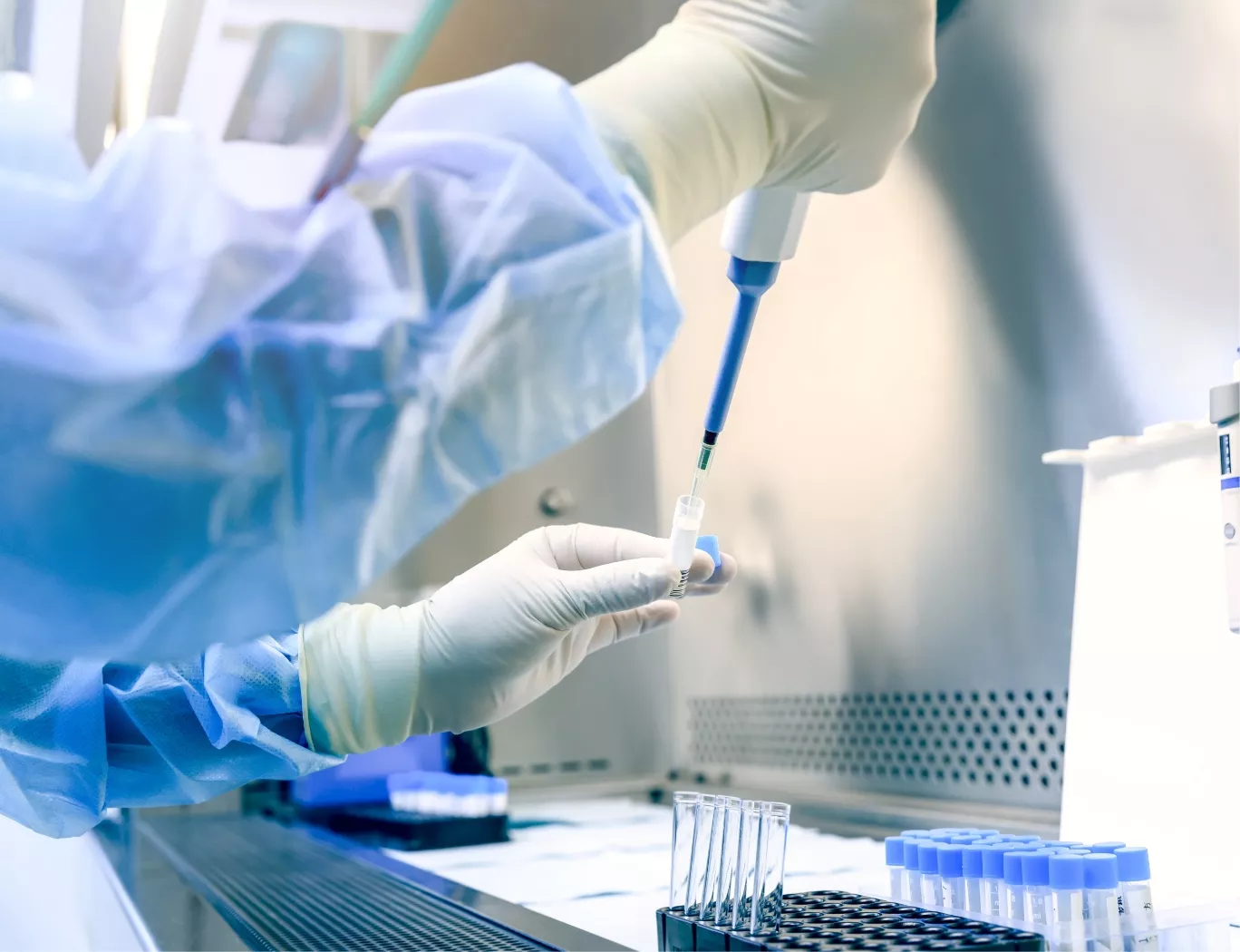
A scientist in protective gear pipetting a sample into a vial within a sterile laboratory hood.

Modality-Specific Program Design

A standard test does not exist for all advanced therapies. Biodistribution study design is tailored to the specific modality and its intended clinical application. For AAV-based vectors, analysis often focuses on capsid-specific tropism, evaluating distribution across serotypes like AAV8 and AAV9. For non-viral systems, such as lipid nanoparticle (LNP) therapy, the study design accounts for the biodistribution profile of the LNP carrier itself.

The ongoing discovery of novel AAV serotypes, which can offer improved tissue-specific gene transfer and circumvent pre-existing immunity, underscores the critical need for detailed biodistribution studies to select the most effective vector for clinical development (PMID: 12192090).

Our teams support analysis across a comprehensive range of sample types to build a complete biodistribution profile.

  • Tissues: Brain, spinal cord, liver, spleen, heart, kidney, lung, muscle, gonads, and injection sites.
  • Fluids: Whole blood, plasma, serum, urine, cerebrospinal fluid (CSF), and feces.

This rigorous approach to biodistribution ensures that sponsors receive a complete data package ready for regulatory submission, supporting program timelines to IND.


Additional Insights

This site tour showcases Franklin Biolabs’ preclinical and bioanalytical facilities, spanning over 100,000 square feet of animal housing and specialized laboratory space.


Scientific Process Diagram

This content is for informational purposes. For guidance specific to your therapeutic program, please contact our team for a consultation.