
CMC Strategy for Polymeric and Hybrid Non-Viral Vectors
PROVEN INTELLIGENCE ACCELERATING NEXT-GENERATION THERAPIES
CMC Strategy for Polymeric and Hybrid Non-Viral Vectors
CELL & GENE | RNA | BIOLOGICS
Proven Intelligence in Non-Viral Vector CMC.
Executive Summary
The development of non-viral vectors, including polymeric and hybrid nanoparticle systems, presents distinct Chemistry, Manufacturing, and Controls (CMC) challenges. These systems are characterized by component complexity, polydispersity, and intricate assembly processes that directly influence therapeutic efficacy and safety profiles. A successful regulatory submission for these next-generation therapeutics depends on a bespoke analytical strategy that can rigorously characterize particle size, charge, payload integrity, and encapsulation efficiency. Franklin Biolabs applies its foundational expertise in complex vectorology to de-risk the path to IND for sponsors developing RNA-based therapies delivered via polymeric or hybrid vectors.
Frequently Asked Questions
What is the primary CMC challenge when developing polymeric vectors for RNA therapeutics?
The primary challenge is managing and characterizing the inherent heterogeneity and polydispersity of the polymer itself. This variability can directly impact particle formation, stability, and in vivo performance. A robust analytical strategy is required to establish tight control over raw material specifications and ensure batch-to-batch consistency for these complex systems.
How does scaling up production of hybrid vectors impact readiness for an IMPD or ATMP submission?
Scaling hybrid vector production requires maintaining precise control over the self-assembly process, where multiple components (e.g., polymers, lipids, targeting ligands) must combine consistently. For an Investigational Medicinal Product Dossier (IMPD) or Advanced Therapy Medicinal Product (ATMP) submission, regulators expect detailed data demonstrating that quality attributes are maintained during scale-up, which necessitates phase-appropriate process validation and analytics.
What are the key regulatory expectations for non-viral vector CMC packages under harmonized ICH guidelines?
Regulators expect a comprehensive data package that demonstrates a deep understanding of the product’s mechanism of action and its quality attributes. This includes robust characterization of raw materials, a well-defined manufacturing process, validated analytical methods to assess identity, purity, and potency, and a thorough stability program. The goal is minimizing clinical risk by proving the product is consistent and well-controlled.
The utility of non-viral vectors for delivering RNA payloads : including mRNA, siRNA, and gRNA : is expanding. Systems based on polymeric nanoparticles, polyplexes, and hybrid lipid-polymer constructs offer significant potential due to their manufacturing scalability and payload flexibility. Their successful clinical translation hinges on a CMC program fundamentally different from those established for viral vectors.
A tailored, science-driven preclinical strategy is required. The physicochemical properties of these nanoparticles are direct determinants of the therapeutic’s biological activity and safety, making them foundational quality attributes.
Core Analytical and Manufacturing Hurdles
Developing a robust CMC package for these modalities requires addressing several unique technical challenges. A proactive approach to analytics and process control is necessary to build a data package suitable for global regulatory review.
-
Component Characterization: Each component, from the polymer to any functional excipients or targeting ligands, must be rigorously characterized. Raw material variability is a primary source of batch failure.
-
Particle Assembly & Polydispersity: The self-assembly process is sensitive to minor changes in process parameters. Controlling particle size, zeta potential, and polydispersity is a constant focus.
-
Payload Integrity and Loading: The manufacturing process must protect the RNA payload from degradation while achieving high encapsulation efficiency. Free and encapsulated RNA must be accurately quantified.
-
Potency Assay Development: Establishing a biologically relevant potency assay that reflects the vector’s mechanism of action is a frequent obstacle for novel platforms.
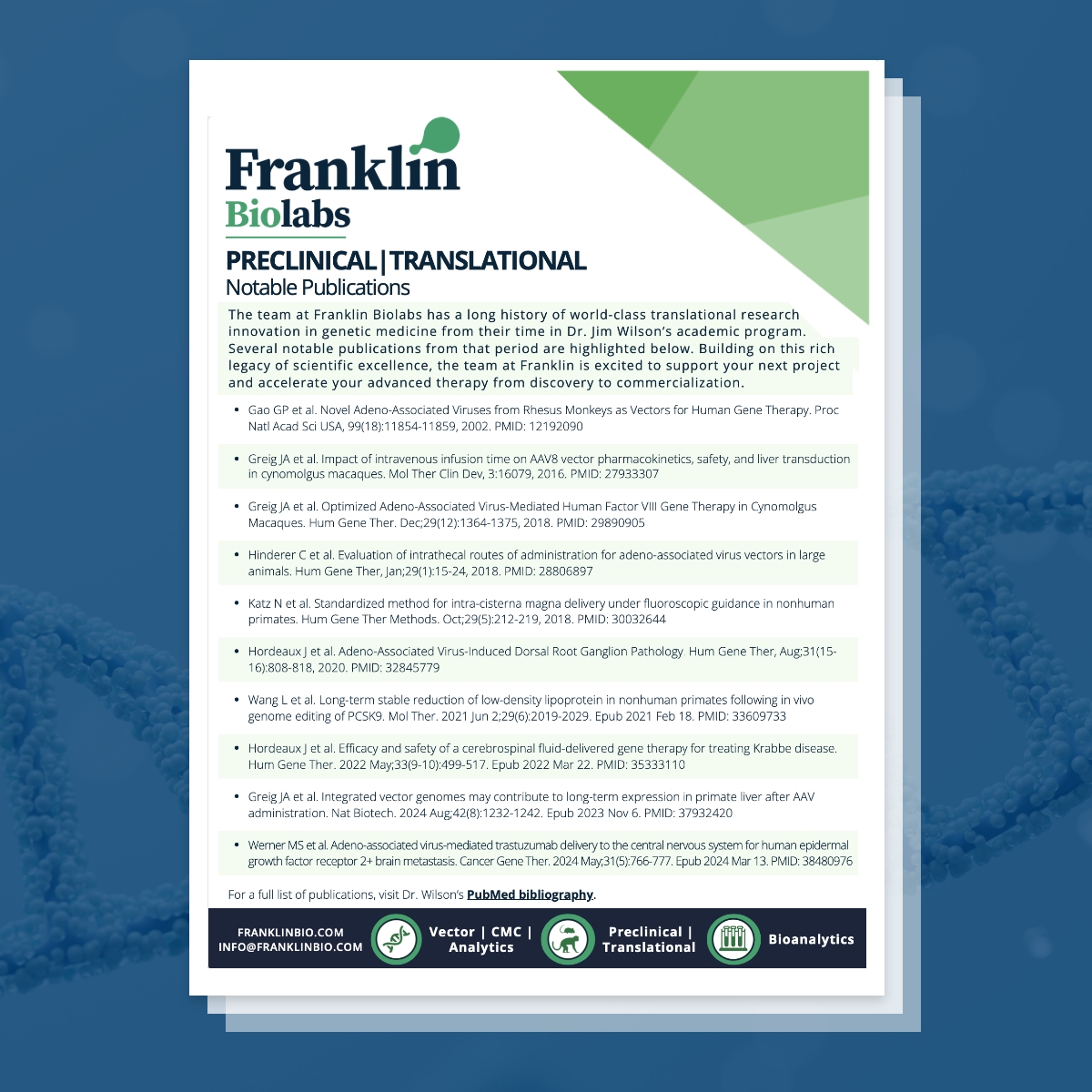
Our approach is informed by deep experience in complex vector characterization. Foundational work in identifying and optimizing novel AAV serotypes (PMID: 12192090) established principles of vector design and in vivo performance that we now apply to non-viral systems. This history provides the framework for developing the sophisticated analytical methods needed to control these synthetic vectors. As one biotech partner noted, we possess a “Vast knowledge in all aspects of vector production and analytics.”
This expertise, which contributed to a 100% successful IND rate for programs our core scientific team has supported since 2019, is directly applicable. While Franklin Biolabs formally launched in 2024, our principal scientists and study directors bring a long track record of navigating complex CMC and regulatory challenges, consistently guiding programs to IND within an 18-24 month timeline. The clinical experience from non-viral gene therapy trials, such as the phase 2b study using a gene-liposome complex for cystic fibrosis (PMID: 26149841), underscores the need for meticulous CMC to interpret clinical outcomes accurately.
Our integrated services, housed within a >100,000 sq ft facility, ensure that process development, analytical testing, and preclinical evaluation are aligned. This structure supports the development of comprehensive data packages that meet harmonized ICH guidelines, facilitating multi-jurisdictional IND and IMPD submissions.
For more information on our foundational capabilities, please see our parent hub page: Vector | CMC | Analytics Services.
Visualizing CMC Attributes of Non-Viral Vectors
The following diagram compares the key CMC considerations for two major classes of non-viral delivery systems: purely polymeric vectors and hybrid lipid-polymer nanoparticles. Understanding these distinctions is central to designing an effective development and manufacturing strategy.

This content is for informational purposes. For guidance specific to your therapeutic program, please contact our team for a consultation.