
Comprehensive Documentation for AAV Capsid Titer and Genome Titer Assay Validation
PROVEN INTELLIGENCE ACCELERATING NEXT-GENERATION THERAPIES
Comprehensive Documentation for AAV Capsid Titer and Genome Titer Assay Validation
AAV Capsid and Genome Titer Assay Validation Documentation
CELL & GENE | RNA | BIOLOGICS
Proven Intelligence Accelerating Next-Generation Therapies.

Executive Summary
For AAV vector programs, the validation and documentation of capsid and genome titer assays are foundational for successful IND and IMPD submissions. An inconsistent or poorly documented analytical strategy introduces significant regulatory risk, potentially delaying timelines. This asset outlines a systematic approach to developing a robust, phase-appropriate validation package that demonstrates analytical control, aligns with GxP expectations, and supports an 18-24 month timeline to IND. The focus is on creating a data narrative that satisfies both FDA and European authorities for Advanced Therapy Medicinal Products (ATMPs).
Frequently Asked Questions
What is the primary difference between validating a genome titer vs. a capsid titer assay?
A genome titer assay (often using qPCR or ddPCR) quantifies the number of viral particles containing the therapeutic gene cassette. A capsid titer assay (typically ELISA-based) measures the total number of viral capsids, both full and empty. Regulators require both to determine the full-to-empty capsid ratio, a key quality attribute.
At what stage should formal GxP validation occur?
Assay development and qualification should begin during the research phase. Formal validation under GxP conditions is executed for the analytics supporting pivotal IND-enabling toxicology studies and the characterization of the clinical manufacturing lot. The approach must be phase-appropriate.
How does capsid serotype affect assay validation?
Different AAV serotypes (e.g., AAV2, AAV8, AAV9) have unique capsid surface proteins. This requires the use of serotype-specific antibodies and reference standards for ELISA-based total capsid titer assays to ensure accuracy and specificity. The validation package must demonstrate the assay is suitable for the specific serotype being manufactured.
What documentation is required for an IND or IMPD submission?
The submission package needs comprehensive validation reports detailing assay specificity, linearity, accuracy, precision (repeatability and intermediate precision), and robustness. Standard Operating Procedures (SOPs) for performing the assays and certificates of analysis for all reference materials are also required.
The Regulatory Expectation for Analytical Control
A common failure point in early-stage viral vector programs is an insufficient analytical data package. Regulators in both the US and Europe expect a clear demonstration of control over the characterization of the vector. The quantitative data from titer assays directly reflects the consistency of the manufacturing process. Discrepancies between genome and capsid titer data can indicate process instability, leading to questions about product quality and patient safety.
Our approach, refined across thousands of research batches and numerous clinical-stage programs, is built on establishing this control early. This ensures the analytical methods used for preclinical lot release are the same methods that will be formally validated for the clinical phase, creating a seamless data bridge.

Linking Capsid Biology to Assay Specificity
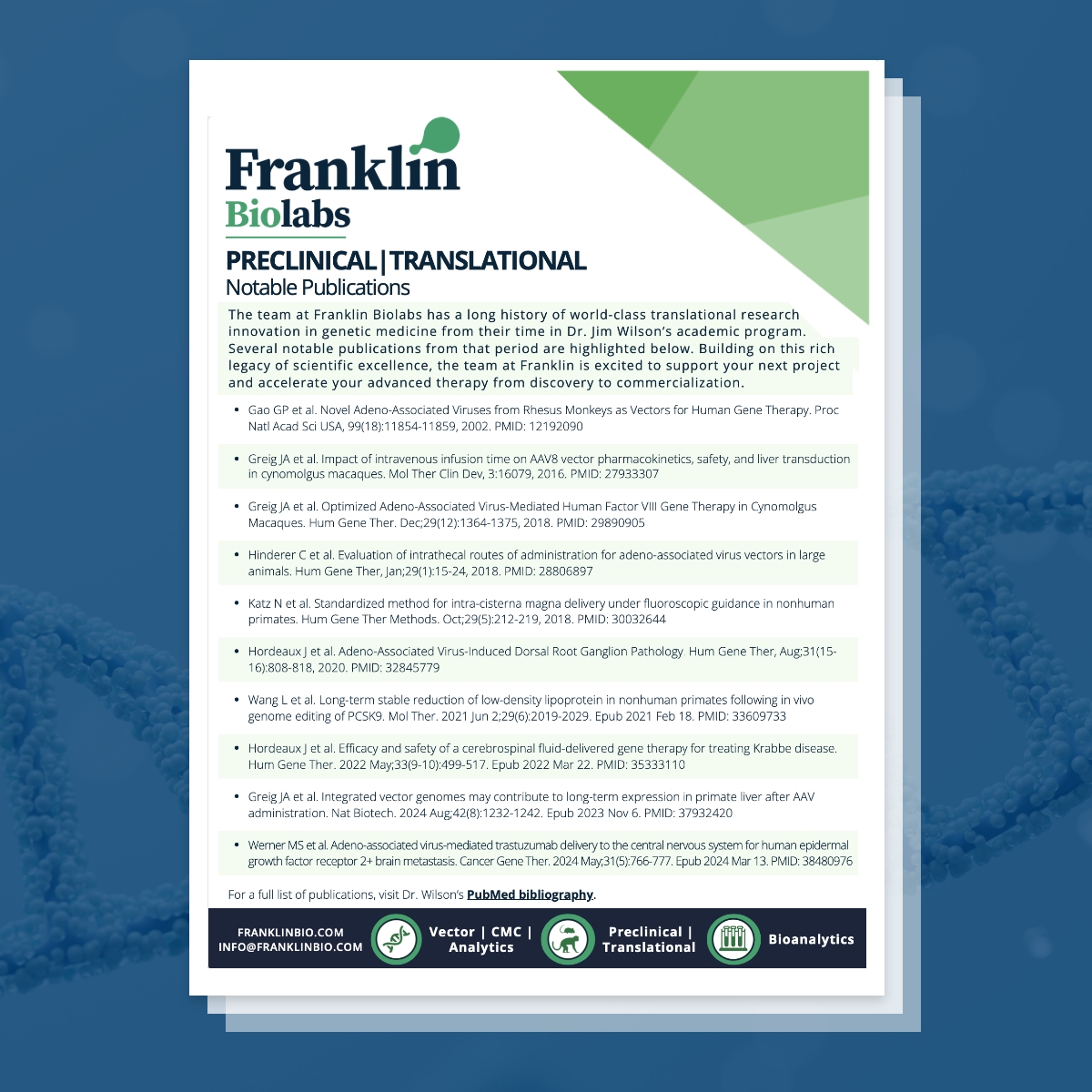
The scientific rationale for an assay’s design is as important as its statistical performance. Understanding the fundamental biology of the AAV capsid informs the development of a specific and reliable quantification method. For example, research identifying specific amino acids on the AAV9 capsid responsible for cell binding (PMID: 22514350) directly impacts the selection of reagents for a capsid titer assay. An assay must be able to accurately quantify the intended vector without cross-reacting with other serotypes or process-related impurities.
This principle extends to demonstrating the vector’s functional competence. Studies confirming that capsid proteins are a primary determinant of successful vector delivery and transduction (PMID: 12829835) underscore the need for accurate titer measurements. The data from these assays feed directly into dose calculations for IND-enabling toxicology studies, making their accuracy a matter of clinical relevance.
“We started collaborating with UPenn Vector core in 2023 and the AAV vector which they manufactured laid a foundation for development of a gene therapy candidate which will enter soon preclinical studies. The key people from UPenn Vector Core joined Franklin Biolabs and our partnership transitioned without interruption from UPenn Vecor Core to Franklin Biolabs Research Vector Division. Franklin Biolabs is our key scientific partner in our AAV-vector based gene therapy candidate development and we hope to continue the partnership for years to come.”
— Biotech Partner
Building a GxP-Compliant Documentation Package
A successful submission relies on a transparent, logical documentation system that supports the complete assay lifecycle and accelerates audit readiness. This involves a complete lifecycle approach to data integrity and reporting.
-
Phase-Appropriate Strategy: We begin with a validation master plan that outlines the qualification and validation activities for each assay, aligning them with the overall program timeline.
-
Detailed SOPs: All analytical procedures are governed by detailed Standard Operating Procedures, ensuring consistency across operators and experiments within our >100,000 sq ft facility.
-
Comprehensive Reporting: Each validation report includes a predefined protocol, all raw data, statistical analysis, and a final summary concluding that the assay is fit for its intended purpose.
-
Reference Standard Management: A well-characterized, homogenous reference standard is produced and maintained with a complete documentation trail, forming the anchor for all subsequent measurements.
This structured approach has contributed to a 100% successful IND rate for programs since 2019, with the Franklin Biolabs brand itself launching in 2024 to continue and expand upon this legacy of scientific execution.

Technical Visualization: AAV Titer Assay Validation & Documentation Workflow

This content is for informational purposes. For guidance specific to your therapeutic program, please contact our team for a consultation.