Cross-Reactivity Assessment in Anti-Drug Antibody Assays for Biosimilar Development Programs

PROVEN INTELLIGENCE ACCELERATING NEXT-GENERATION THERAPIES

Cross-Reactivity Assessment in Anti-Drug Antibody Assays for Biosimilar Development Programs

Cross-Reactivity Assessment in Anti-Drug Antibody Assays for Biosimilar Development

CELL & GENE | RNA | BIOLOGICS

For a biosimilar development program, demonstrating equivalent immunogenicity to the reference product is a regulatory requirement. The core of this demonstration is an anti-drug antibody (ADA) assay that can detect antibodies with equal sensitivity against both the biosimilar and the innovator molecule. A cross-reactivity assessment is the technical validation that confirms this capability, de-risking the comparative clinical study by ensuring that observed immunogenicity rates are a true reflection of the product profiles, not an artifact of assay bias.

    What is the primary goal of an ADA cross-reactivity assessment for a biosimilar?

    A: The goal is to scientifically prove that a single immunogenicity assay detects ADAs against the biosimilar and the reference product with equivalent sensitivity and drug tolerance. This ensures any differences observed in clinical samples are due to the products, not the assay itself.

    Why can’t we just use the reference product’s validated ADA assay?

    A: An assay validated only for the reference product may not adequately detect antibodies elicited by the biosimilar, especially if minor structural differences lead to unique epitopes. A cross-reactivity assessment qualifies the assay for both molecules, establishing it as a suitable tool for a comparative study.

    How do pre-existing antibodies affect cross-reactivity analysis?

    A: Pre-existing antibodies can bind to both the biosimilar and reference product, creating a baseline signal that complicates the interpretation of treatment-emergent ADAs. It is vital to characterize this baseline and ensure the assay can distinguish it from a de novo response, as natural exposures can induce broad cross-reactive responses.

    What defines a “comparative immunogenicity” study design?

    A: This design involves a head-to-head clinical trial where the incidence, titer, and neutralizing capacity of ADAs are compared between cohorts receiving the biosimilar and the reference product. The entire design relies on a single, validated, cross-reactive assay to provide unbiased data for the comparison.

A scientist in protective gear pipetting a sample into a vial within a sterile laboratory hood.

Validating Therapeutic Equivalence Through Precision Immunogenicity Profiling

In biosimilar development, the analytical and clinical data must converge to support a demonstration of no clinically meaningful differences from the reference product. A cornerstone of this effort is the comparative immunogenicity assessment. The development of a single, robust anti-drug antibody assay that is equally responsive to antibodies directed against either the biosimilar or the innovator molecule is a non-trivial bioanalytical challenge.

This process requires a rigorous cross-reactivity evaluation to confirm the assay’s performance characteristics. Without this validation, any data generated in a comparative clinical trial is scientifically indefensible, as it would be impossible to discern whether observed differences in ADA rates are real or simply a function of assay bias.

Navigating Pre-Existing Immunity and In Vitro Limitations

The interpretation of immunogenicity data is often complicated by factors independent of the therapeutic protein itself. A significant variable is the presence of pre-existing antibodies in study subjects. As analogous research into biologic vectors has demonstrated, a history of natural exposure can result in a complex baseline of cross-reactive antibodies (PMID: 27314914). This baseline can interfere with the accurate detection of treatment-emergent ADAs, requiring highly specific and well-characterized assays to differentiate between the two.

The predictive value of bioanalytical methods must also be carefully considered. Studies have highlighted potential discrepancies where in vitro assay results do not fully predict the biological activity observed in vivo (PMID: 19279092). This principle underscores the need for immunogenicity assays that are not only analytically sound but also reflect a deep understanding of the biological context. This level of detail is central to our approach: Immunogenicity Intelligence for Advanced Therapies.

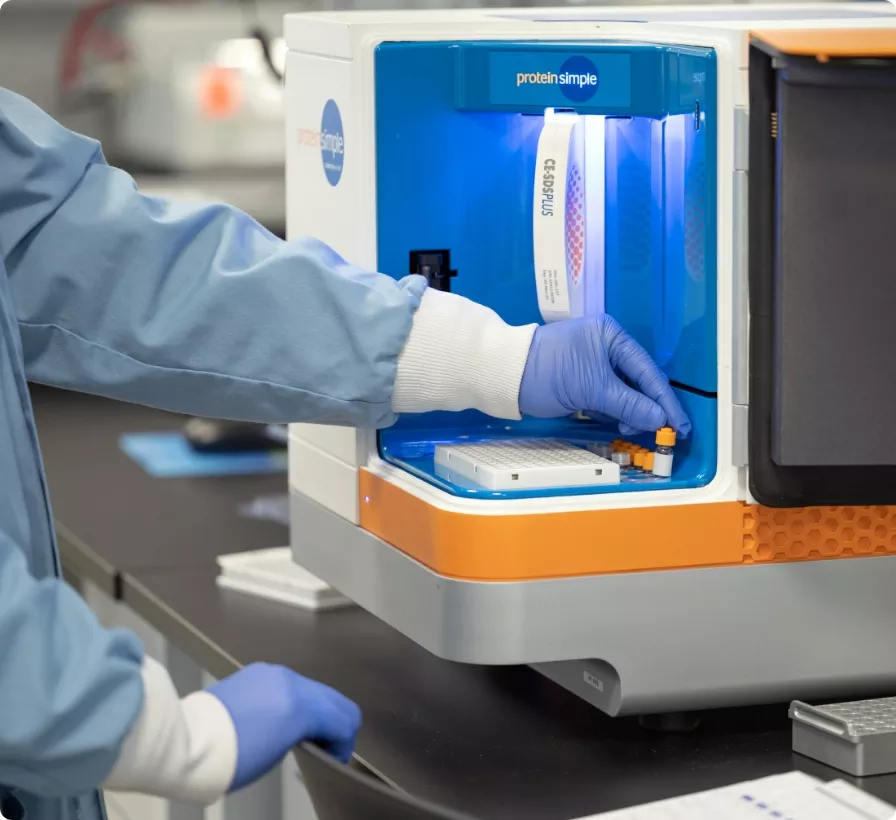
A scientist in a lab coat and gloves loads samples into a ProteinSimple instrument for analysis.

A Framework for Robust Cross-Reactivity Validation

Franklin Biolabs executes cross-reactivity assessments within a GxP framework designed to meet global regulatory expectations for biosimilar programs. Our approach, supported by over 100,000 sq ft of facility space, including advanced laboratories and animal housing, focuses on developing and validating a single assay to mitigate inter-assay variability. This streamlined bioanalytical strategy is a key component in helping our partners meet accelerated development goals, such as an 18-24 month IND timeline.

Our validation process includes several key evaluations:

  • Comparative Sensitivity: Confirming the assay’s lower limit of detection is equivalent using positive controls generated against both the biosimilar and the reference product.

  • Equivalent Drug Tolerance: Ensuring the assay can detect ADAs in the presence of equivalent concentrations of either the biosimilar or reference drug.

  • Specificity & Selectivity: Verifying that the assay signal is specific to the target drug class and is not affected by matrix interference.

  • Reagent Qualification: Utilizing highly characterized reagents and leveraging platforms from strategic partners like Meso Scale Discovery to achieve maximum sensitivity and reproducibility.

Watch the full video on how process optimization accelerates research

Scientific Process Diagram

This content is for informational purposes. For guidance specific to your therapeutic program, please contact our team for a consultation.